
Time to Read:
A Global Assignment can change much more than where an employee works. It can also change how their working time, holidays, time off, accruals and time-related payroll data need to be managed.
This is where Global Assignment and Time Management in SAP SuccessFactors can become challenging.
An employee may move temporarily from a home employment to a host employment, but the organization still needs to decide which Time Management rules should apply during the assignment, what happens to existing balances, and how everything should transition when the employee returns.
This article looks at those Time Management considerations and the key decisions HRIS and Time Management teams should make before configuration.
What changes in Time Management during a Global Assignment?
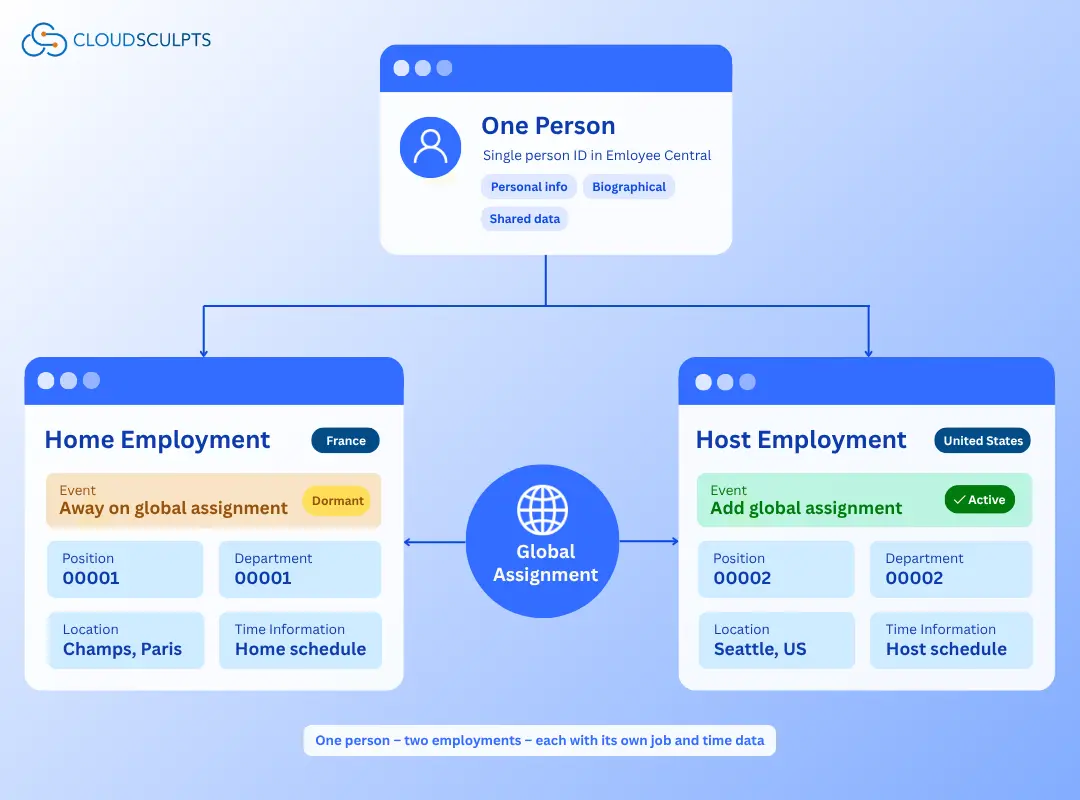
A Global Assignment creates a temporary international employment arrangement, with the employee retaining their home employment while working under a host employment.
From a Time Management perspective, this raises a different set of requirements depending on the type of assignment, as shown below:
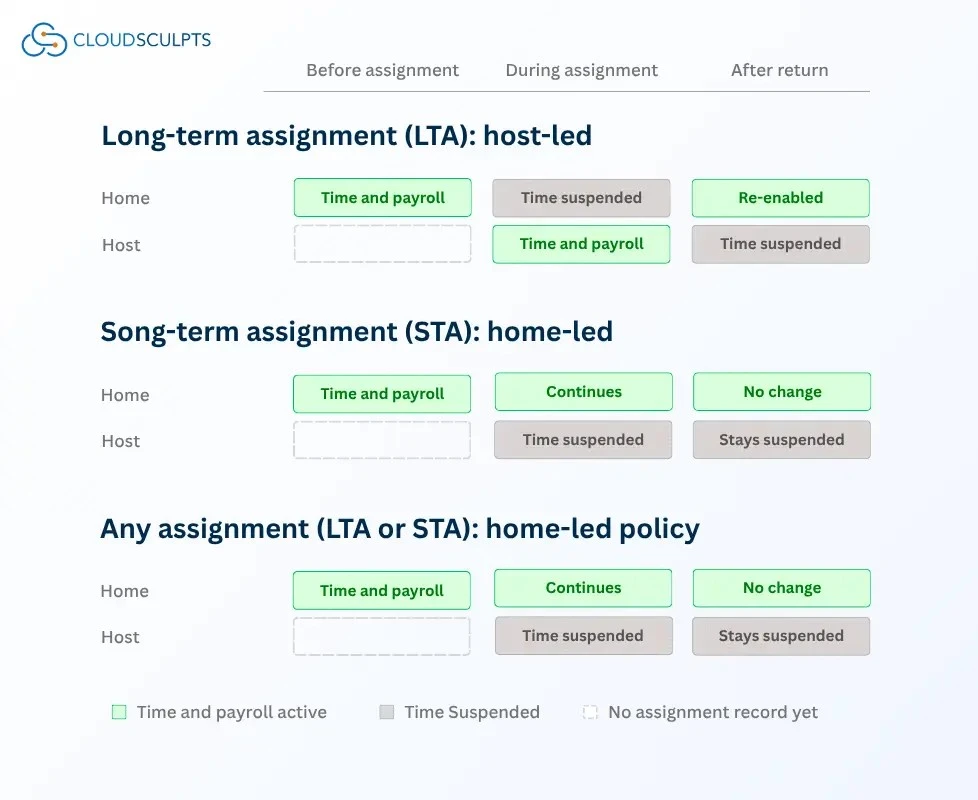
In a long-term assignment (LTA), the host employment usually leads time and payroll, and time is suspended in the home employment. In a short-term assignment (STA), the home employment continues to lead, and time is suspended in the host employment. Some organizations apply the home-led model to every assignment, regardless of its duration.
The important point is that a Global Assignment does not automatically mean that every Time Management setting simply moves from the home employment to the host employment.
The organization needs to decide how each area should work during the assignment.
The core design question: should Time Management follow Home or Host?
One of the most important decisions is determining which employment should drive each part of Time Management.
There may not be one answer for everything. The answer becomes clearer when you work through the scenarios that typically arise before, during and after an assignment.
Design areas to agree
- Time account balances at the start and end.
Decide whether vacation and time-off balances are frozen, carried over, converted or paid out when the leading employment switches. - Work schedule and holiday calendar.
On an STA, the employee physically works in the host country while time runs from home, so you need to decide whose public holidays and working pattern apply. This question comes up frequently in practice. - Home record should remain unchanged.
For example, maternity leave or long-term sickness while on assignment: which employment records it, and does it pause or end the assignment? - Split payroll or shadow payroll.
Some setups need time data in both countries at the same time, for example for host tax or social security reporting. This breaks the clean “one side suspended” model.
Changes during the assignment
- Early return or curtailment.
The end date moves in. Time must be re-enabled earlier in the employment that takes back the lead, and any absences or time records entered beyond the new end date may sit on the wrong employment. - Extension of the assignment.
The planned end date moves out, so the suspension window must move with it. Absences or time sheets already planned around the original return date should be reviewed. - Cancellation before the start date.
If the assignment is withdrawn before it begins, any suspension must be reversed cleanly so that no time data is lost in the home employment. - Conversion from STA to LTA, or LTA to STA.
This changes which employment leads time and payroll partway through the assignment. It is the most complex scenario, because both the leading employment and the time account balances change hands. - Retroactive date changes.
When assignment dates are corrected after the fact, approved time sheets, absences and time valuations need to be recalculated against the right employment.
End-of-assignment variants
- Time account balances at the start and end.
Decide whether vacation and time-off balances are frozen, carried over, converted or paid out when the leading employment switches. - Work schedule and holiday calendar.
On an STA, the employee physically works in the host country while time runs from home, so you need to decide whose public holidays and working pattern apply. This question comes up frequently in practice. - Leave of absence during the assignment.
For example, maternity leave or long-term sickness while on assignment: which employment records it, and does it pause or end the assignment? - Split payroll or shadow payroll.
Some setups need time data in both countries at the same time, for example for host tax or social security reporting. This breaks the clean “one side suspended” model.
A technical solution is not the answer to every problem. A Global Assignment is also an opportunity for the business to simplify and harmonize its processes, so that they work globally while still meeting local policy and compliance requirements.
In the following sections, we discuss these key questions and the solutions available in SAP SuccessFactors.
The objective is not simply to determine whether SAP can store the employee’s home and host employment. It is to define how the employee’s time should be managed while those employment relationships coexist.
Current SAP SuccessFactors considerations
Global Assignment creates a separate employment with its own user ID, the home and host employments can each have their own time data setup. The approach below meets almost all requirements, apart from the limitations described in the next section below.
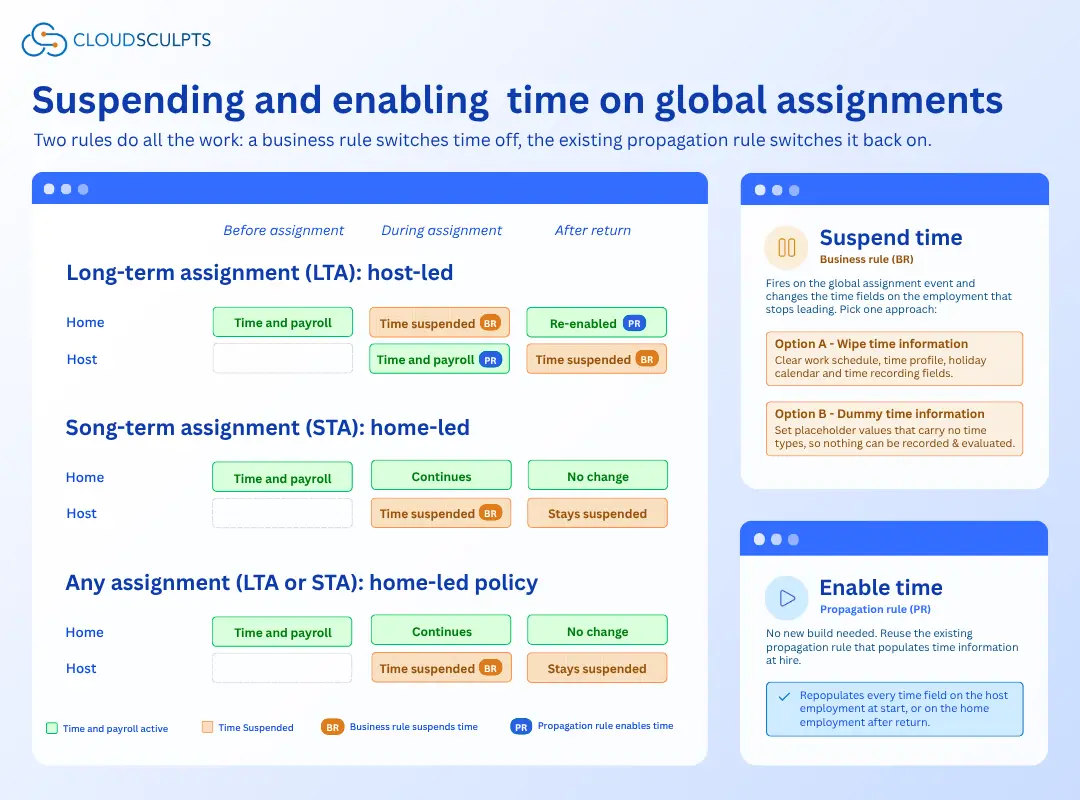
Suspending time. When the Global Assignment starts, or when the employee returns, a business rule can be configured to change the time information on the employment that stops leading. There are two options:
- Wipe the time information: clear the work schedule, time profile, holiday calendar and time recording fields.
- Assign dummy time information: set placeholder values that carry no time types, so that nothing can be recorded or evaluated.
Enabling time. No new build is needed. The existing propagation rule that populates time information at hire repopulates the time fields on the employment that takes the lead.
Make sure the business rule is tied to the event reasons used for Global Assignment start, end, extension and cancellation, so that it fires only when intended, and test each of these events.
Known limitations to plan for
- Termination end handling is not triggered when a Global Assignment ends.
If you want to delimit or close the time accounts at the end of a Global Assignment, you have to do it manually. Source: SAP Help Portal - Leave the home assignment alone.
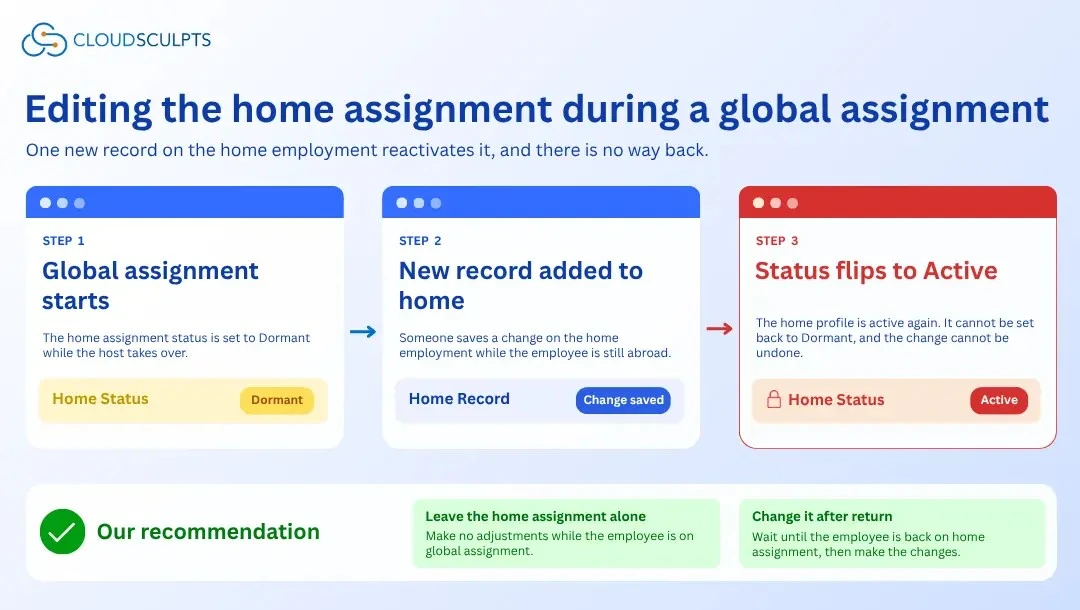
When an employee is placed on Global Assignment, their home assignment status is set to Dormant. If new records are added to the home employment, the system sets it back to Active, and this status change cannot be undone. Avoid adjustments to the home assignment during the Global Assignment, and make any required changes once the employee is back on their home assignment. Source: SAP Help Portal - In a Global Assignment, Employment Details are not visible.
If the original start date, last employment start date or any other date field is used to calculate entitlements in the host country, you will need an integration or a custom solution to provide it. - Time accounts and absences belong to each employment.
Balances do not move automatically between the home and host employments, so any transfer, freeze or payout must be handled by your process, for example through manual adjustments or time account payouts.
What happens to existing time balances?
This is one of the practical questions that should be answered before a Global Assignment begins.
An employee may already have accrued time or time-off balances under the home employment. The organisation should define what happens to those balances when the host assignment starts.
For example:
- Are existing balances retained under the home employment?
- Can they be used during the assignment?
- Are they paid off?
- Does the host employment have separate balances?
- Are new host-country entitlements accrued?
- What happens to unused balances when the employee returns?
- How are balances handled if the assignment is extended or ends early?
There is no value in designing the host Time Management setup without first understanding what happens to the employee’s existing time data
The key principle is simple: Time Management needs to be designed for the full assignment lifecycle, not just the assignment start.
Global Assignment and Payroll: Where Does Time Data Go?
Time Management and Payroll are closely connected, particularly when an employee is working under a host employment.
The organisation needs to understand which time data is relevant to payroll and which employment or payroll arrangement should consume it.
Questions may include
- Which employment is payroll-relevant: will payroll run in the home country or the host country?
- What drives the decision to run payroll in the home or host country?
- Which time types need to flow to payroll?
- Are home and host payroll arrangements both involved?
- How are overtime or other time-related payments handled?
- What happens to time data when the assignment ends?
Payroll design should therefore be considered alongside Time Management rather than treated as a completely separate downstream activity.
Time Management, Integrations and Reporting
The complexity can increase when Time Management data moves from Employee Central into other systems.
Depending on the organization’s landscape, this may include payroll, SAP ERP HCM, SAP S/4HANA, reporting platforms or other HR systems.
The key question is: Which employment does the downstream system consume for Time Management data?
Integration teams should also establish:
- Which employment-level data is transferred
- Which identifiers are used
- Which time data is relevant
- How changes are handled
- What happens during an extension or early return
- How the end of the assignment is reflected downstream
Testing should cover more than the initial assignment. The solution should be validated across the relevant lifecycle scenarios and any country-specific requirements.
Assignment start → Time Management changes → Extension → Early return → Assignment end → Return
Reporting should also distinguish between person-level information and employment-level information where that distinction matters.
Frequently Asked Questions
Can an employee record time against both home and host employment during a Global Assignment?
This depends on how the employment structure, time-recording process, and downstream systems are designed. The key is to establish which employment is responsible for recording and processing the employee’s time and whether the business requires time data to be associated with both employments.
How should time recording be handled when an employee works across multiple countries during a Global Assignment?
When an employee works across countries, the organization needs to consider which working-time rules, schedules, and holiday calendars apply to each location. The solution should reflect the employee’s actual work arrangement and the relevant local requirements.
What happens to Time Management when a Global Assignment is extended?
An extension should trigger a review of the employee’s Time Management setup, including work schedule, holidays, Time Off, accruals, accounts and payroll-related time data where applicable.
Can a Global Assignment be extended without changing the employee’s Time Management setup?
Yes, in many cases. If the assignment is extended but the employee’s working arrangements remain unchanged, the existing setup may still be appropriate. However, the extension should still trigger a review of any time-related rules, entitlements, or payroll requirements affected by the new assignment period.
What happens to Time Management when an employee returns from a Global Assignment?
The organisation should define how the employee transitions back to the home employment, including the applicable Time Profile, work schedule, holidays, Time Off, accounts, accruals and treatment of remaining balances.
Conclusion
Global Assignment and Time Management in SAP SuccessFactors should not be treated as two separate design decisions.
The assignment may change the employee’s employment context, but the organization still needs to decide how the employee’s working time should be managed within that context.
The strongest designs therefore start with the business requirement and work outward:
Business requirement → Employment model → Time Management design → Assignment lifecycle → Payroll and Integrations → SAP Configuration
The configuration is important, but it should follow the decisions rather than define them.
How CloudSculpts can help with Global Assignment and Time Management?
At CloudSculpts, we bring hands-on experience designing and implementing complex SAP SuccessFactors solutions for global organisations across IT consulting, pharmaceuticals, telecommunications and networking, and other industries.
Our work involves understanding how different business requirements, employment structures, and regional policies affect the way SAP SuccessFactors is designed and configured. For Global Assignment and Time Management, this means helping organisations assess their home and host employment models, working-time requirements, time-off policies, payroll dependencies, and integration needs.
Whether you’re planning a new SAP SuccessFactors Implementation, reviewing an existing setup, or addressing a specific challenge with Global Assignment and Time Management, our team can help you evaluate the requirements, identify potential gaps, and define a practical solution that fits your organization’s needs.
About the Author:

Navpreet Kaur
Technology Lead & Co-founder of CloudSculpts
Helping global organisations get the most from SAP SuccessFactors, with a passion for Time Management and Integration. Outside work, I’m usually chasing new ideas—or the perfect cup of Tea.